
Formal standards and industry standards ensure that Digital Product Passports work across systems
Digital Product Passports must work across company, industry and system boundaries. This Deep Dive explains the role of European DPP formal standards and industry standards, how they work together and what they mean for companies implementing the Digital Product Passport.
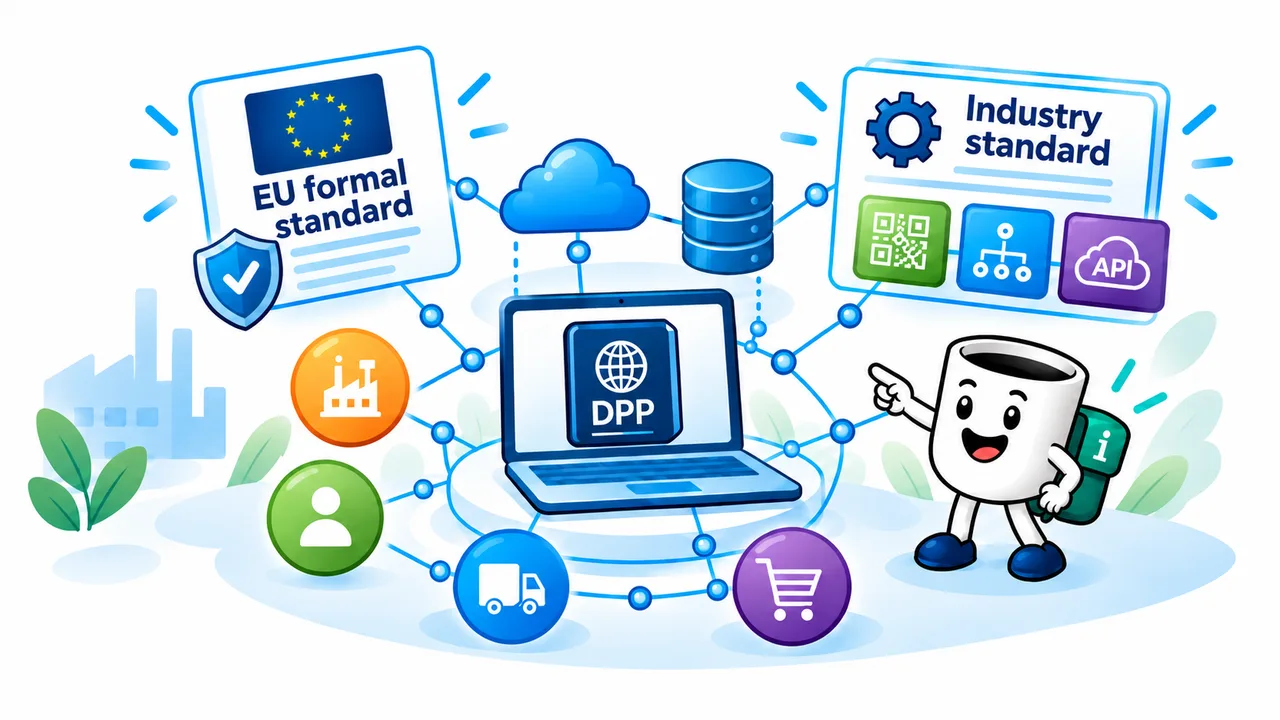
The Digital Product Passport is intended to make product information available across company, industry and system boundaries. Different manufacturers, suppliers, retailers, authorities, repair companies and recycling companies may work with different IT systems.
For these systems to work together nonetheless, they need common rules. For example, they must be able to identify unambiguously
- which product a DPP belongs to,
- how the DPP is accessed via a data carrier,
- how information is exchanged and stored,
- what the exchanged information means,
- which users may access which data and
- how the authenticity and integrity of the information can be verified.
These common foundations are created through European formal standards and other industry standards. Without common rules, individual companies could develop their own Digital Product Passports. However, there would be a risk of creating isolated solutions that are disconnected from one another:
- One system cannot process another system's identifier.
- A data carrier does not reliably lead to the correct DPP.
- The same information is designated differently and is therefore understood differently.
- Interfaces are not compatible with one another.
- Access rights are implemented differently.
- Information cannot be used throughout the entire product life cycle.
The eight DPP formal standards published to date focus on the technical framework of the DPP system. Further standardisation work may supplement and develop this framework in the future.
In focus
Together, the European DPP standards and industry standards create a technical foundation for the DPP. They do not prescribe the same software or platform for every company. The formal standards define common requirements and interfaces; industry standards provide suitable building blocks for their implementation.
What is the difference between a formal standard and an industry standard?
In everyday language, the terms are often used synonymously. However, there is a difference. The specific difference lies not primarily in what they regulate, but in how they are created and what formal status they have:
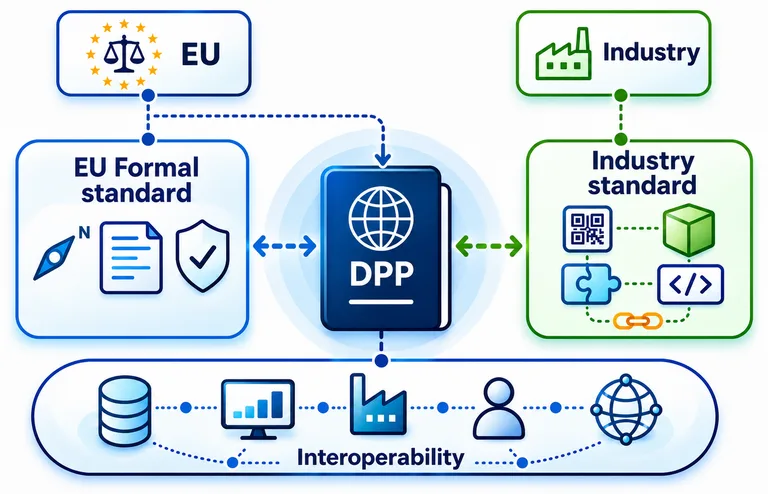
- A formal standard establishes jointly agreed rules and is published through a formal procedure by a recognised standardisation organisation.
- An industry standard also establishes rules or technical solutions, but is developed by a company, association or consortium without going through a formal standardisation procedure. An industry standard can become widely used in the market and form an important basis for technical solutions without being a standard in the formal sense.
Formal standards
A formal standard is developed by a recognised standardisation organisation through a formal procedure. Interested experts work together and agree on the content by consensus. Recognised European standardisation organisations include:
- CEN – European Committee for Standardization
- CENELEC – European Committee for Electrotechnical Standardization
- ETSI – European Telecommunications Standards Institute
A European Standard is designated EN. It is then adopted by the national standardisation organisations. In Germany, for example, it appears as DIN EN.
The European Commission issued a standardisation request to CEN, CENELEC and ETSI for the Digital Product Passport. The aim was to develop the technical framework for the DPP infrastructure. This took place in the joint technical committee CEN-CLC/JTC 24 “Digital Product Passport – Framework and System”.
The eight DPP formal standards resulting from this work are modular and interconnected. Each standard addresses a specific component of the DPP system. Together, they form the horizontal technical framework intended for use with different product groups.
Six standards were published on 27 May 2026. Their references were published in the Official Journal of the European Union on 15 July 2026. The two remaining standards on access rights and data security, EN 18239 and EN 18246, followed in mid-September 2026. All eight European DPP standards are therefore now available. The publication of references to the remaining two standards in the Official Journal of the European Union is planned for November 2026.
Industry standards
An industry standard is developed by an industry organisation, an industry consortium or an individual provider. One example is the identification and data exchange standards of the international standardisation organisation GS1. They ensure that products, companies, locations and data can be identified and marked according to uniform technical rules and exchanged between different parties and systems.
How legislation, formal standards and industry standards work together
Three levels can be distinguished for the Digital Product Passport:
Level | Task |
|---|---|
EU legislation | Defines which products are affected, what information will be required and when the obligations apply |
European DPP formal standards | Define common technical requirements for the DPP system |
Industry standards | Provide concrete technical building blocks, for example for identifiers, data carriers or data exchange |
- EU legislation—in particular regulations, delegated acts and implementing acts—therefore primarily answers the question of what a company must provide.
- Formal standards, by contrast, have so far primarily answered the question of which common technical rules should be used to implement the DPP.
- Industry standards provide concrete procedures for meeting these requirements.
In focus
The current eight European DPP formal standards therefore do not define which environmental, safety or product information a battery passport, a textile passport or the DPP of a construction product must contain. Instead, they create the common technical framework for assigning, exchanging, storing, protecting and understanding this information consistently across systems. This makes them the foundation for the interoperability of the DPP ecosystem.
What does interoperability mean for the DPP?
Interoperability means that different systems can work together. For the Digital Product Passport, interoperability concerns both the technical connection between systems (Technical interoperability) and the shared understanding of the exchanged information (Semantic interoperability).
Technical interoperability is enabled by common identifiers, data carriers, data formats, exchange protocols and interfaces.
Semantic interoperability requires terms, properties, units and relationships to be described unambiguously and understood in the same way by different systems.
Which formal standards support technical interoperability?
Technical interoperability is not established by a single formal standard. Several DPP formal standards work together for this purpose:
- EN 18219 governs unique identifiers.
- EN 18220 addresses data carriers and the connection between the physical product and its DPP.
- EN 18216 defines requirements for exchanging DPP data.
- EN 18222 describes application programming interfaces for searching for and managing DPPs.
- EN 18221 addresses the storage, archiving and long-term availability of data.
- EN 18223 establishes overarching rules for how these building blocks work together.
CEN/CENELEC jointly assigns these formal standards to the area of interoperability and data exchange; EN 18223 is assigned the overarching role of system interoperability and also takes semantic interoperability into account.
Which formal standard supports semantic interoperability?
EN 18223 establishes overarching rules for how DPP systems work together. These include common terminologies, basic data structures and the connection of semantic repositories.
However, the specific meanings of product-specific information are not created by this formal standard alone. Additional common data models, term definitions, controlled vocabularies and other domain-specific standards are also required.
For example, different systems can then distinguish unambiguously whether a statement describes a material, a recycled content percentage, a repair status or another product property.
The Deep Dive “The eight European DPP formal standards in detail” provides a concise overview of the tasks and interaction of the eight European DPP standards.
What do the formal standards mean for companies?
For companies, the formal standards provide guidance and facilitate legally compliant implementation without prescribing a single technical solution. They provide a common framework within which different solutions compliant with the standards can be used.
The formal standards provide guidance
Companies do not have to invent the technical principles of the Digital Product Passport themselves.
The formal standards provide a common framework for key questions:
- How is a product linked unambiguously to its DPP?
- How can data be exchanged between different systems?
- How is information stored and kept available over the long term?
- How are access rights regulated?
- How is confidential information protected?
- How can the authenticity and integrity of data be secured?
The formal standards thereby reduce the number of fundamental decisions that each company would otherwise have to make on its own.
The formal standards do not prescribe uniform software
Companies do not have to use the same software, the same platform or the same DPP service provider.
Depending on the product, existing system landscape and business model, they can select different suitable technical solutions.
What matters is that the selected building blocks of the company's DPP infrastructure:
- meet the requirements of the formal standards,
- can work with the European DPP system and
- comply with the product-specific requirements to be issued later.
Different solutions must still work together
The scope for technical decisions ends where an isolated solution would emerge.
The key message is:
Companies can choose between different solutions that comply with the formal standards. What matters is not that everyone follows the same path, but that the selected solutions work together interoperably within the DPP ecosystem.
Harmonised standards make it easier to demonstrate conformity
A European standard published by CEN or CENELEC is not automatically a harmonised standard with legal effect. For this to be the case, its reference must also be published in the Official Journal of the European Union. Only then does its correct application give rise to a presumption of conformity. This means:
If the requirements contained in the standard are met, it is initially assumed that the corresponding legal requirements have also been met.
This is sometimes informally referred to as a “leap of faith”. However, the correct technical term is presumption of conformity. The presumption of conformity:
- makes it easier to provide evidence to market surveillance authorities,
- reduces the effort required for justification and testing,
- reduces liability risks, and
- can reduce the costs of demonstrating conformity.
However, it is not an unrestricted free pass. The company must apply and document the standard correctly. In addition, the presumption applies only to the legal requirements actually covered by the respective standard. CEN/CENELEC summarises the logic as follows: Companies apply harmonised standards voluntarily, document their application, and declare conformity; the authorities can then initially assume conformity.
The application of harmonised standards is generally voluntary. Companies may also choose an alternative technical solution. In that case, however, they must independently provide comprehensible evidence that this solution meets the legal requirements.
Six standards were published in May 2026 and cited in the Official Journal of the European Union on 15 July 2026. The two standards EN 18239 and EN 18246, covering access rights and data security, followed in mid-September 2026. This means that all eight European DPP standards are now available. The citation of the two final standards in the Official Journal is still pending and is currently scheduled for November 2026.
What the formal standards do not decide
The eight horizontal DPP standards do not answer all questions relating to a specific Digital Product Passport.
For example, they do not conclusively determine:
- which products require a DPP,
- when the obligation applies,
- whether a DPP is created at the model, batch, or individual product level,
- which mandatory information must be included,
- which data carrier is mandatory for a specific product group,
- which information is publicly accessible or access-restricted, or
- how long individual data must remain available.
These requirements are defined by the applicable EU legislation, including relevant product-specific delegated acts or implementing acts.
Key takeaway
The current eight horizontal DPP standards establish a common technical framework for interoperable Digital Product Passports. They do not define the product-specific mandatory information; instead, they establish common requirements for how DPP information can be uniquely assigned, exchanged, stored, protected and understood across systems.
Within this framework, companies can use different solutions that comply with the standards. Applying harmonised standards also makes it easier to demonstrate that the legal requirements they cover have been met.
Sources
- Regulation (EU) 2024/1781 of the European Parliament and of the Council of 13 June 2024 establishing a framework for the setting of ecodesign requirements for sustainable products
- Commission Implementing Decision (EU) 2026/1736 of 14 July 2026 on harmonized standards for Digital Product Passports
- CEN/CENELEC: How to become compliant with EU Digital Product Passport legislations: Guidance on the recent published European standards, Webinar, 25 June 2026
- EN 18216:2026 – Digital product passport – Data exchange protocols
- EN 18219:2026 – Digital product passport – Unique identifiers
- EN 18220:2026 – Digital product passport – Data carriers
- EN 18221:2026 – Digital product passport – Data storage, archiving, and data persistence
- EN 18222:2026 – Digital Product Passport – Application Programming Interfaces (APIs) for the product passport lifecycle management and searchability
- EN 18223:2026 – Digital Product Passport – System interoperability
- EN 18239:2026 – Digital Product Passport – Access rights management, information system security, and business confidentiality
- EN 18246:2026 – Digital Product Passport – Data authentication, reliability and integrity