
The eight European DPP formal standards in detail
The eight European DPP standards establish the technical framework for the Digital Product Passport.
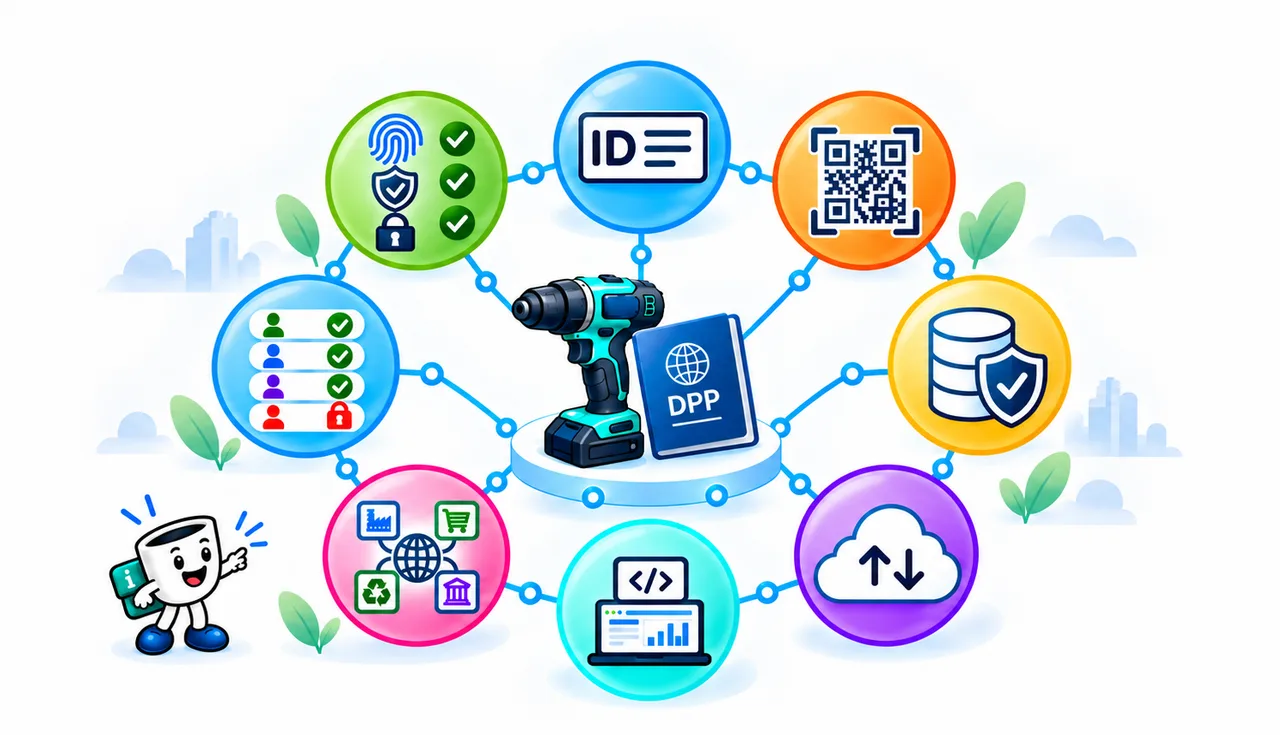
What do formal standards actually do?
Formal standards translate legal requirements into common rules, thereby creating a basis for consistent implementation. The Deep Dive "Formal standards and industry standards ensure that Digital Product Passports work across systems" explains in detail how formal standards interact with legal requirements and industry standards.
This Deep Dive provides a more detailed introduction to the European DPP standards series published in 2026 and explains the role of each of the eight standards within the DPP system.
How is the European DPP standards series structured?
The European DPP standards series EN 182xx comprises eight modular standards that are functionally interconnected. Each standard addresses a specific component of the DPP system. Their interaction enables a technically interoperable and reliable Digital Product Passport.
The standards series describes how products and DPPs can be unambiguously linked, data stored and exchanged, access rights regulated, and authenticity, integrity, and cross-system understanding ensured. In simplified terms, its system logic follows this sequence:
Uniquely identify the product → link the data carrier to the product → store and make DPP data available → exchange data technically → find and manage the DPP through interfaces → enable interoperable interaction between systems and a shared understanding of the meaning of the data → control access rights → safeguard authenticity and integrity.
The rules for system interoperability connect several of these steps and ensure their joint technical and semantic interaction.
Six standards were published in May 2026 and cited in the Official Journal of the European Union on 15 July 2026. The two standards on access rights and data security followed in mid-September 2026. The European DPP standards series EN 182xx is therefore now complete. The citation of the two final standards in the Official Journal of the European Union (OJEU) is still pending and, according to the current schedule, is planned for November 2026.
What does the DPP standards series not specify?
The DPP standards series does not specify which product-specific information a Digital Product Passport must contain. Such requirements are defined by the applicable EU legislation and the associated product-specific delegated acts.
What role does each standard in the DPP standards series play?
EN 18219:2026 – Unique identifiers
EN 18219 specifies requirements for unique identifiers in the DPP system. They can be used to uniquely identify products, economic operators, and facilities and assign them to the associated digital information.
The unique product identifier is particularly important for the DPP. It ensures that a product is linked to exactly the DPP intended for that product. Depending on the applicable product-specific regulation, the identifier may refer to a product model, a batch, or an individual product.
The standard does not prescribe a specific identification system for all companies. It defines requirements that a suitable system must meet so that identifiers are unique, permanently usable, machine-readable, and usable across systems. Established identification standards developed by industry organisations can be used for this purpose. One example is the Global Trade Item Number (GTIN) of the GS1 standards organisation. Whether a GTIN alone is sufficient or must be supplemented by additional identifiers depends on whether the DPP is provided at the model, batch, or individual-product level.
In simple termsEN 18219 ensures that the right Digital Product Passport can be unambiguously assigned to the right product.
EN 18220:2026 – Data carriers
EN 18220 specifies requirements for data carriers through which a Digital Product Passport can be accessed from the physical product. The data carrier contains the unique identifier in encoded form and thereby establishes the link between the product and its Digital Product Passport.
Various technical solutions may generally be used as data carriers, including QR codes, DataMatrix codes, NFC, and various RFID technologies. The solution prescribed or suitable for a particular product group may be further specified by the applicable product-specific legislation.
The standard addresses, among other things, the encoding, readability, accessibility, durability, and placement of the data carrier. This is intended to ensure reliable access to the DPP throughout the product life cycle for which it is intended.
In simple termsEN 18220 describes how the Digital Product Passport can be accessed reliably from the physical product.
EN 18221:2026 – Data storage, archiving, and data persistence
EN 18221 addresses the storage, archiving, and long-term availability (“persistence”) of DPP data. It specifies requirements to ensure that information can be stored and retrieved reliably during the required period.
In this context, long-term data availability means that DPP information is not lost and remains reliably accessible later, even if individual systems, services, or responsibilities change.
The standard is technology-neutral. It therefore does not require companies to use a specific database, storage platform, or provider. What matters is that the selected solution meets the requirements for availability, retention, and interoperability.
The current backup copy of the DPP generally provided for in the ESPR (Ecodesign for Sustainable Products Regulation) is a specific application of these requirements for storage, backup, and long-term availability. It is maintained by a DPP service provider (Digital Product Passport service provider) and is intended to ensure that the DPP remains available even if the responsible economic operator ceases operations, becomes insolvent, or is liquidated.
In simple termsEN 18221 ensures that DPP information remains reliably available not only today, but also later.
EN 18216:2026 – Data exchange protocols
EN 18216 establishes common technical rules for processing and exchanging DPP data. These include protocols and data formats that enable information to be transmitted between different systems.
Such common rules ensure that DPP data can be used across different systems rather than being confined to a single system. Other software solutions should also be able to access, process, and reuse it. The standard therefore supports technical interoperability and reduces the risk of isolated solutions.
EN 18216 thus provides a technical prerequisite for cross-system data exchange. It specifies how DPP data is transmitted technically, but not what the exchanged information means in terms of content. The overarching rules required for this concerning terminologies, data structures, and semantics are addressed in EN 18223:2026 (see the section after next).
In simple termsEN 18216 establishes common technical “rules of the road” for exchanging DPP data.
EN 18222:2026 – APIs for life cycle management and discoverability
EN 18222 specifies requirements for application programming interfaces. These interfaces are known as APIs (application programming interfaces) and enable software systems to communicate with one another automatically. Through these interfaces, DPPs can be automatically searched for, retrieved, registered in the EU DPP registry, updated, and managed throughout the product life cycle. APIs therefore connect different applications and technical services, eliminating the need for manual data transfers between them.
APIs also play a central role in linking the unique identifier to the DPP's storage location. This enables systems to automatically find the associated DPP and access the information available to them.
In simple termsEN 18222 specifies how software systems can automatically find and manage a Digital Product Passport.
EN 18223:2026 – System interoperability and semantic understanding
The standard establishes overarching rules for how the different components of the DPP system interact and how DPP data can be understood consistently across systems.
It addresses both technical interoperability and fundamental prerequisites for semantic interoperability. Technical interoperability enables data exchange between systems. Semantic interoperability ensures that these systems also understand the exchanged information in the same way.
EN 18223 includes overarching DPP terminologies, a core data model, and rules for the structure and technical representation of data. It also takes into account the integration of the EU DPP registry and semantic repositories.
However, the standard does not by itself define all product-specific terms and data fields. The specific semantics for batteries, textiles, construction products, or other product groups are additionally determined by product-specific delegated acts, data models, terminologies, and domain-specific standards.
Such terms, data models, and vocabularies can be provided, managed, and made accessible to different systems in semantic repositories. One example that is already accessible is the DPP Vocabulary Hub used as part of the European CIRPASS-2* project. Common semantic models and vocabularies for different product groups can be provided and managed there.
When the DPP registry was launched in July 2026, the European Commission also provided a semantic repository for the DPP registry. It serves as the authoritative reference for the semantic meaning, structure, versioning, and interoperability of DPP data and is being gradually expanded to include data models and semantic definitions for additional product groups. Companies can access machine-readable data models, definitions, and vocabularies through documented APIs. However, a direct publicly accessible entry point to the semantic repository or the documented APIs has not yet been published (as of August 2026).
*CIRPASS-2 is a research and innovation project that tests Digital Product Passports in real-world use cases and also addresses their interoperability.
In simple termsEN 18223 ensures that different systems can not only exchange DPP data, but also understand it in the same way.
EN 18239:2026 – Access rights, information security, and confidentiality
Not all information in a Digital Product Passport is intended for all user groups. While certain information may be publicly accessible, other information may only be accessed by authorities, repair businesses, recycling companies, or other authorised parties.
EN 18239 establishes requirements for managing such access rights. It also addresses the security of the information systems involved, as well as the protection of personal data and confidential business information.
Access rights define which information a person or system may read, add, or edit. The standard establishes a common framework for this, which can then be specified in greater detail by the relevant product-specific legislation.
In simple termsEN 18239 governs who may access which DPP information and how confidential data is protected.
EN 18246:2026 – Authenticity, reliability, and integrity of data
EN 18246 establishes requirements for the authenticity, reliability, and integrity of DPP data. It therefore helps verify whether information comes from a traceable source and whether it has been altered without detection.
Authenticity concerns the genuineness or origin of the data. Integrity means that the information is complete and has not been altered without detection. Reliability concerns the trustworthiness of the data and the processes used to provide and process it.
These requirements are particularly important because DPP data can be provided and updated by different parties and transferred across multiple systems. Users and authorities must be able to assess whether the retrieved information relates to the correct product and is reliable.
In simple termsEN 18246 helps ensure that DPP data is authentic and reliable and has not been altered without detection.
How do the eight standards work together?
The eight standards are closely interconnected and should be considered together. For example, a unique identifier is only useful if it is linked to the product via a suitable data carrier and leads to the correct DPP through an interface. The associated DPP must be stored and kept permanently available. At the same time, rules must define who may access the information and how its authenticity and integrity are safeguarded.
Cross-cutting rules for system interoperability ensure that these components work together.
What do the eight standards mean for companies?
What the eight standards mean for companies is explained in detail in the Deep Dive Formal standards and industry standards ensure that Digital Product Passports work across systems.
RememberTogether, the eight European DPP standards published to date form the horizontal technical framework of the DPP system. Each standard has a specific role:
- from uniquely identifying the product and linking it to its DPP
- through storage, data exchange, automated discoverability, and management of access rights
- to safeguarding authenticity and integrity
Cross-cutting rules for system interoperability connect these tasks technically and semantically.The standards do not prescribe a specific technical solution. Instead, they establish common requirements to ensure that different standards-compliant systems and components can work together reliably and that DPP data remains usable and understandable across systems.
Sources
- Regulation (EU) 2024/1781 of the European Parliament and of the Council of 13 June 2024 establishing a framework for the setting of ecodesign requirements for sustainable products (ESPR).
- Commission Implementing Regulation (EU) 2026/1778 of 16 July 2026 laying down the implementing rules for the digital product passport registry established under Regulation (EU) 2024/1781 of the European Parliament and of the Council.
- European Commission: Digital Product Passport – Frequently Asked Questions (FAQ), Version 1.0, February 2026.
- CEN-CENELEC: How to become compliant with EU Digital Product Passport legislations: Guidance on the recent published European standards, webinar, 25 June 2026.
- CEN-CENELEC: Standardisation Request M/604 and M/604 Amd 1 concerning the Digital Product Passport.
- Commission Implementing Decision (EU) 2026/1736 of 14 July 2026 on harmonised standards for Digital Product Passports.
- CIRPASS-2: DPP Vocabulary Hub, accessed via dpp.vocabulary-hub.eu.
- European Commission (DG GROW): The EU Digital Product Passport for Batteries – Webinar 2 – Latest Updates, Key Requirements and Industry Perspectives, 7 July 2026.
- European Commission (DG GROW): DPP Registry User Guide for Economic Operators, Version 1.0, 17 July 2026.