
Which industries will be required to use a DPP — and which information will become important when?
The Digital Product Passport is being introduced step by step. Find out which product groups will be affected first and which information will become important for companies, from initial orientation through implementation.
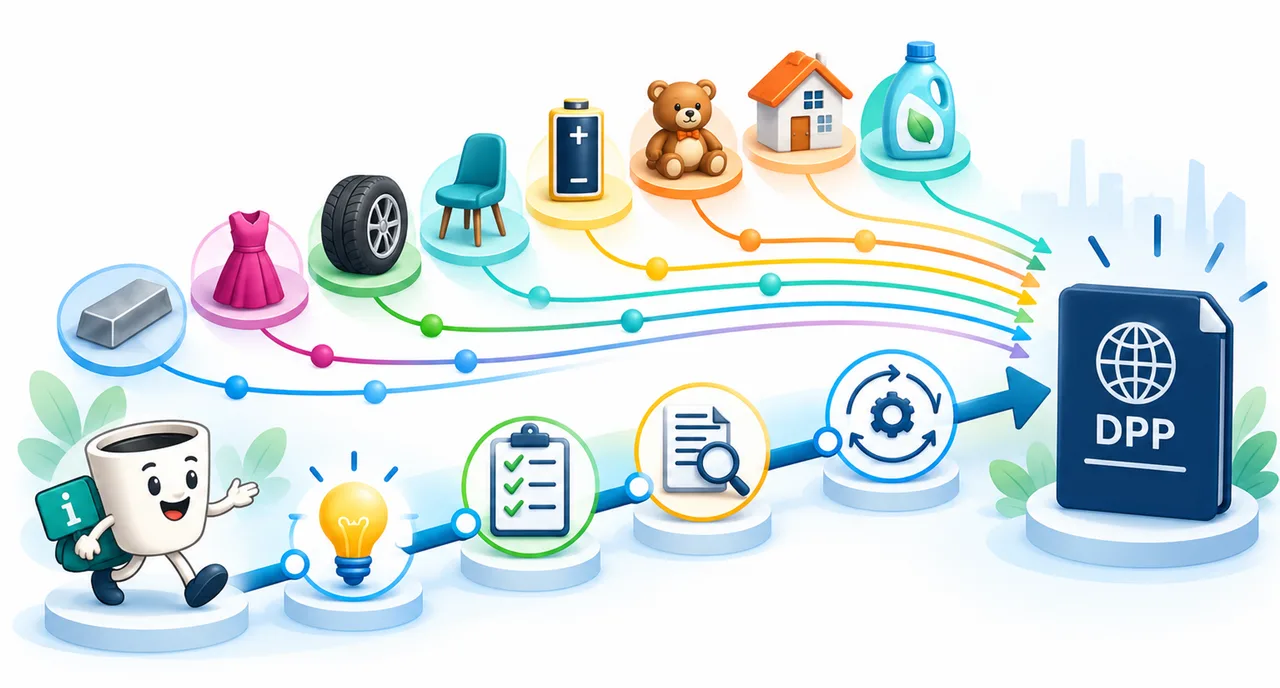
The Digital Product Passport will not become mandatory for all products and industries at the same time. The European Union is introducing it gradually: in part on the basis of the ESPR (Ecodesign for Sustainable Products Regulation), and in part through standalone sectoral EU regulations.
This creates different timelines for companies. It also changes which information becomes important to them and when: initially, the focus is on understanding the principles and objectives of the DPP. The closer a company’s own product group gets to a binding regulation, the more important specific requirements, deadlines, data and implementation processes become.
Which legal provisions determine the DPP obligation?
In the long term, the Digital Product Passport may be relevant for a large proportion of the products placed on the market or put into service in the European Union. However, whether and when a company actually has to provide a DPP depends on its products and the legal provisions applicable to them.
DPP requirements arise in two ways.
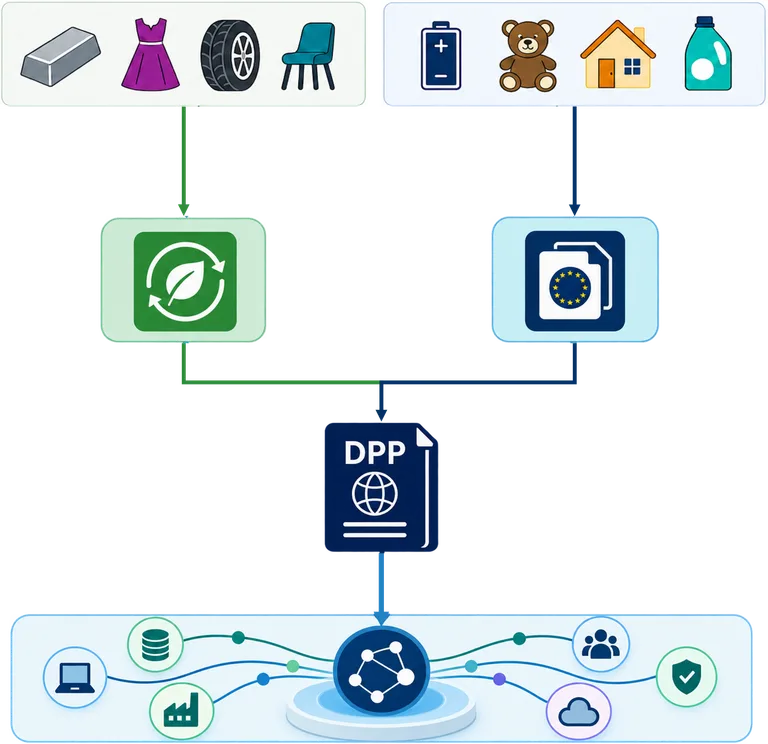
DPP requirements under the ESPR
The ESPR provides the general legal framework. The specific requirements for individual product groups are subsequently laid down in delegated acts.
DPP requirements under sector-specific EU regulations
Standalone sectoral EU regulations already contain provisions on the Digital Product Passport for certain product groups. These include, among others, batteries, toys, construction products, and detergents and surfactants.
Depending on the regulation, delegated acts or implementing acts may further specify the specific requirements for the Digital Product Passport—in particular its content and obligations. However, all Digital Product Passports are intended to use the same basic technical system. The product-specific content and obligations may differ.
Prioritised product groups and regulatory roadmaps
The European Commission does not determine the order at random. It particularly prioritises product groups with
- High environmental and climate relevance,
- High resource or energy consumption,
- Significant potential for repair, reuse and recycling,
- High economic importance,
- Particular safety relevance, or
- A recognisable need for regulatory action.
The ESPR Working Plan 2025–2030 prioritises, among others, the following product groups:
- Iron and steel
- Aluminium
- Textiles and clothing
- Tyres
- Furniture
- Mattresses
- Various energy-related products
For construction products, the requirements are specified gradually on the basis of the Construction Products Regulation Working Plan 2026–2029. It determines which product families will be harmonised gradually and specified through delegated acts. Other product groups are already subject to standalone sectoral EU regulations with product-specific provisions and implementation deadlines.
What is the status of the individual product groups?
The Deep Dive “Which DPP requirements apply to which product groups?” and the DPP timeline show which product groups are currently prioritised and which regulatory milestones apply.
Why companies should start addressing the DPP now
The DPP is not a standalone IT project that can be completed quickly by simply attaching a QR code. Companies must understand the regulatory, organisational, information technology and editorial interrelationships.
Preparation takes time because the required product information is often
- held in different specialist departments,
- distributed across several IT systems,
- provided by suppliers or other value chain actors,
- available in different formats,
- not defined consistently, or
- not yet assigned to clearly defined responsibilities.
Because many of the foundations of the Digital Product Passport are comparable across industries and the differences primarily concern the specific mandatory information and product-specific requirements, companies can already use this time to understand the basic principles of the DPP and assess its potential impact on their business.
The publication of the relevant delegated act is therefore not the beginning of the orientation process, but the point at which the preparation already completed is supplemented based on the specific requirements.
What information do companies need at each stage?
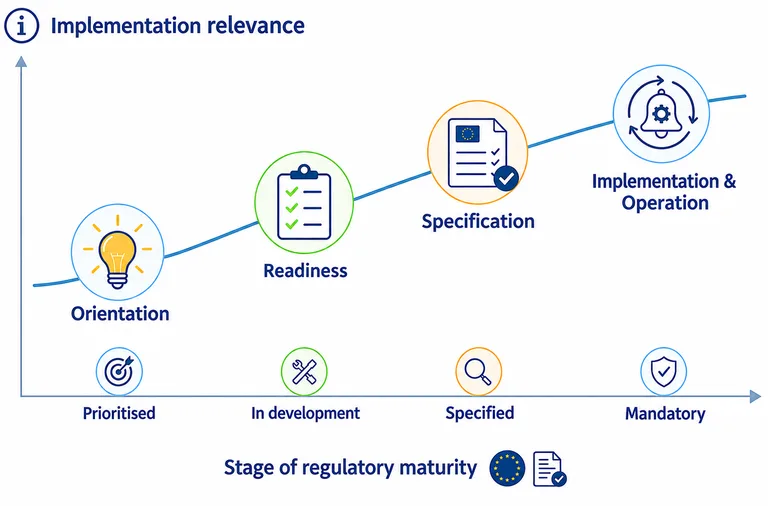
01 – Orientation
At the beginning, the focus is on the principles:
- What is the Digital Product Passport?
- What objectives is the European Union pursuing?
- What role do transparency and the circular economy play?
- How are the ESPR, sector-specific regulations and delegated acts related?
- What benefits can the DPP offer beyond the legal obligation?
- Could the company’s own product group be affected in principle?
At this stage, the focus is not yet on every individual data field. The goal is to establish a shared understanding within the company.
02 — Readiness
As soon as it becomes clear that the company’s own product group is prioritised or covered by a sector-specific regulation, the company’s initial situation takes centre stage:
- Which products and product variants are affected?
- Which information is already available?
- Which departments, documents and systems contain it?
- Which information comes from suppliers?
- Who is responsible for data quality, approval and maintenance?
- Does the company have the required expertise, or does it need support with preparation?
A sensible first step is therefore to assess the company’s own product group and then identify data sources, specialist departments and responsibilities.
03 — Specification
With the publication of the applicable legal act, the product-specific requirements become binding and are specified in detail.
The following questions, among others, are now the focus:
- When do the requirements apply?
- Is there a transition period?
As a general rule, the following applies to delegated acts based on the ESPR: their date of application may not be earlier than 18 months after their entry into force. Deviations are possible in justified cases. The specific deadline must therefore always be checked in the relevant legal act. Different deadlines and transitional arrangements may apply to sector-specific regulations. - Which evidence and documents are required for the DPP? Do they have to be included in the DPP, or can they be referenced?
- At what level is the information required: model, batch or individualdproduct?
- Which data formats and identifiers apply?
- Which semantic data model applies? Are there multiple semantic data models to choose from?
- Which mandatory information must be included?
- Which access rights must be provided for?
- Does existing product information need to be updated? If so, which information and how often?
04 — Implementation and operation
During the implementation phase, regulatory and specialist requirements become a sustainable information process that can be operated over the long term:
- Close data gaps
- Structure and harmonise information
- Ensure data quality
- Integrate suppliers
- Define responsibilities and approvals
- Connect interfaces and systems
- Provide and register the DPP
- Update information and keep it available over the long term
It is important to clarify which tasks the company can handle itself and where it needs support — for example, from a DPP service provider or a consultant. Implementation does not end with the initial publication. Depending on the product group, information must be maintained, supplemented or updated throughout the product life cycle.
Remember
The ESPR provides the general legal framework for the Digital Product Passport. However, sectoral EU regulations may constitute the applicable legal basis for individual product groups—for example, batteries, toys, construction products, or detergents and surfactants.
Depending on the product group, the specific requirements are established in different ways: through delegated acts based on the ESPR, directly through a sectoral EU regulation, or through a combination of a sectoral regulation and supplementary delegated or implementing acts. This is precisely why DPP requirements develop by industry rather than for all products at the same time.
Companies gradually need increasingly specific information and answers — from the general principles to the specific requirements for their own product group.
Sources
- Regulation (EU) 2024/1781 of the European Parliament and of the Council of 13 June 2024 establishing a framework for the setting of ecodesign requirements for sustainable products (ESPR)
- European Commission: Ecodesign for Sustainable Products and Energy Labelling Working Plan 2025–2030, 16 April 2025.
- European Commission: Construction Products Regulation Working Plan 2026–2029, 16 December 2025.
- European Commission: Digital Product Passport – Frequently Asked Questions (FAQ), Version 1.0, February 2026.
- Regulation (EU) 2023/1542 of the European Parliament and of the Council of 12 July 2023 concerning batteries and waste batteries
- Regulation (EU) 2025/2509 of the European Parliament and of the Council of 26 November 2025 on the safety of toys
- Regulation (EU) 2024/3110 of the European Parliament and of the Council of 27 November 2024 laying down harmonized rules for the marketing of construction products
- Regulation (EU) 2026/405 of the European Parliament and of the Council of 11 February 2026 on detergents and surfactants
- European Commission (DG GROW): The EU Digital Product Passport for Batteries – Webinar 2 – Latest Updates, Key Requirements and Industry Perspectives, 7 July 2026.
- CEN-CENELEC: How to become compliant with EU Digital Product Passport legislations: Guidance on the recent published European standards, Webinar, 25 June 2026.
- Joint Research Centre: Methodology for defining data requirements for the Digital Product Passport under the ESPR framework, 19 March 2026.
- Joint Research Centre: Study on DPP content for iron and steel products under the ESPR, 23 March 2026.